Chapter 3 - The Ghost's Ledger
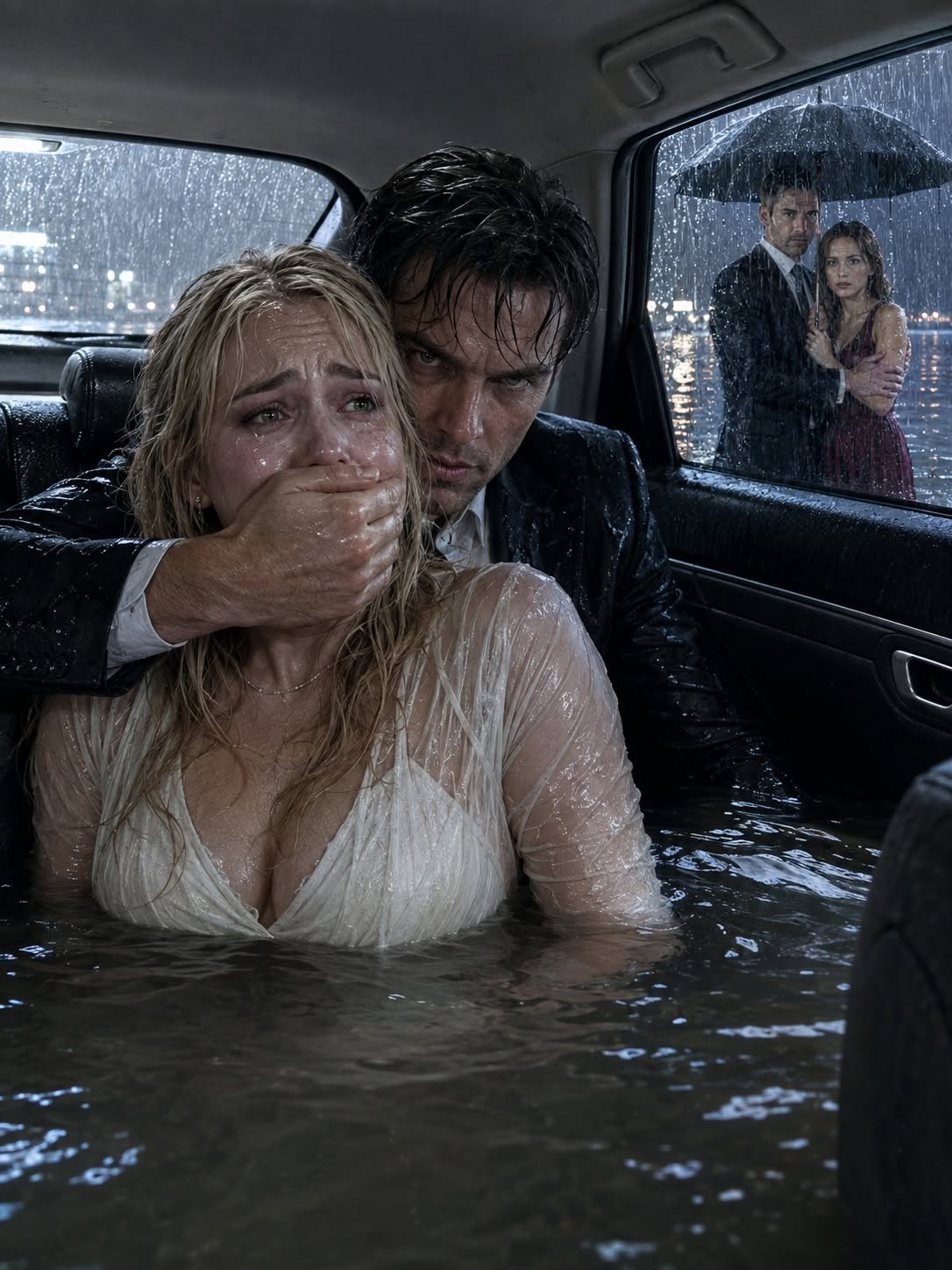
We stayed submerged in the freezing river mud beneath the abandoned coal pier for two hours.
The rain turned into a torrential downpour, blinding the shoreline and masking the sound of our breathing. In the distance, the wail of emergency sirens began to echo across the water—first two, then four, their red and blue lights flashing rhythmically through the mist near the shattered guardrail of the coastal highway.
We watched through the pier timbers as two state police cruisers, a fire truck, and an ambulance pulled up to the embankment.
Julian was there.
He had performed a masterclass in performative grief. He was sitting on the lowered tailgate of an emergency vehicle, wrapped in an orange shock blanket, his hair drenched, his head buried in his hands. His shoulders shook with shuddering, dramatic sobs as a state trooper rested a comforting hand on his back.
Chloe stood nearby, wrapped in her own blanket, tears streaming down her face as she spoke to a deputy sheriff, pointing frantically toward the deep water where our Lincoln Navigator sat at the bottom of the channel.
"Look at him," I whispered, the rage inside my chest suddenly burning hotter than the freezing cold of the water. "He's going to go home to our house. He's going to lie in our bed."
"No," Mason said firmly, grabbing my shoulder to keep me grounded. "He's going to go to your house, search your safe for the corporate ledger, and then he's going to call his handlers in Richmond. And that gives us exactly six hours."
"Six hours for what?"
"To die," Mason said.
He pulled me back down into the water, leading me through the shallow, reed-choked marshes beneath the shoreline, moving entirely within the blind spots of the police searchlights above.
We crawled out of the river half a mile downstream, hidden by a dense forest of loblolly pines and sweetgum trees. My clothes were heavy, soaked through, weighing fifty pounds, and my body was shaking so violently from hypothermia that I could barely keep my feet beneath me.
Mason didn't hesitate. He reached down, scooped me up into his arms with terrifying, effortless strength, and began walking through the dense brush with the fast, measured stride of a trained soldier.
"Where are we going?" I gasped, my teeth clicking together so hard my jaw hurt.
"To the place Dad built before he died," Mason said, not even breathing heavily despite carrying my full weight up the muddy incline. "The place nobody knows about. Not even Chloe."
Twenty minutes later, deep within a neglected five-acre tract of woodland that had belonged to our grandfather's estate, Mason stopped before an old, rusted corrugated-tin tobacco barn.
The structure looked completely abandoned—its roof was caved in on the western side, covered in thick Virginia creeper vines and fallen timber.
Mason walked around to the rear of the structure, kicked away a pile of rotting firewood, and pressed his palm against a smooth, gray slab of concrete buried in the earth.
A quiet click echoed through the trees.
The concrete slab—a disguised hydraulic hatch—swung upward with a low, pneumatic hiss.
Warm, dry air scented with pine wood, gun oil, and lithium batteries rushed out from the darkness below.
Mason carried me down a steep flight of concrete stairs, hit a switch on the wall, and the heavy hatch sealed shut above us, cutting off the sound of the rain and sirens completely.
The bunker beneath the tobacco barn was a sixty-foot square underground room lined with reinforced concrete walls, industrial steel shelving, and fluorescent tube lighting powered by a quiet solar-inverter bank built into the roof frame above.
On one side sat two heavy oak desks covered in computer monitors, radio equipment, and stacks of black leather-bound ledgers. On the other side stood six lockable steel armoires and a fully equipped medical station with a surgical bed, IV racks, and racks of pharmaceutical supplies.
Mason set me down gently on a stainless-steel chair near an electric space heater, pulled a dry wool blanket from a shelf, and wrapped it tightly around my shoulders.
I sat there, frozen, staring at the room, then at my brother.
He walked over to a steel locker, pulled out a dry pair of tactical pants and a black wool sweater, and began changing out of his soaked clothes with complete, casual unconcern.
His back was broad, covered in long, thin white scars that ran from his shoulder blades down to his lower spine—scars I had never seen before in my life.
"You weren't paralyzed," I whispered, my voice breaking. "You've been walking. You've been coming here."
Mason pulled the black sweater over his head, smoothing his wet hair back from his face.
He walked over to the oak desk, opened a small key-code safe, and pulled out a thick, faded blue ledger stamped with the seal of the United States Department of the Navy, dated 2011.
He set the ledger down on the table in front of me.
"Fifteen years ago," Mason said softly, leaning against the desk and crossing his arms, "Dad discovered that forty percent of the high-grade steel used in the hull construction of the Navy's new fast-attack submarines was being falsified. The foundry in Norfolk was supplying sub-standard alloy, stamping it with forged certification seals, and pocketing fifty million dollars in surplus profits."
I stared at the ledger. "Dad run the shipyard... he was the primary contractor."
"Yes," Mason said. "And when he refused to take the bribe to sign off on the metallurgy reports, they cut his brake lines on Route 17."
I felt the room spin around me. "The car crash..."
"Mom died instantly," Mason continued, his voice dropping into a flat, terrifyingly precise rhythm. "I was twelve. I survived with two broken ribs and a concussion. But while I was lying in the hospital room in Norfolk, two men in gray suits walked in with Dr. Mercer. They told me that if I ever spoke a word about what Dad had told me the night before the crash, they wouldn't just kill me. They would kill my seven-year-old sister, Valerie."
I put my hands over my face, a violent shudder tearing through my chest.
"Dr. Mercer gave me a choice," Mason whispered. "He said if I spent the rest of my life in a wheelchair—if I became a helpless, harmless cripple who posed zero threat to their operations—they would leave you alone. They would let you grow up, let you take over the shipyard, and let you run the commercial side of the business."
"So you sat in that chair..." I sobbed, looking up at him through tears. "For fifteen years? You acted like you couldn't feel your legs? You let me bathe you? You let me push you through every doctor's office in the country?"
"Every single day," Mason said, his gray eyes filling with tears for the first time. "Every time you cried because an experimental therapy failed, every time you spent your own money trying to buy me custom leg braces, every time you sat beside my bed at night praying for a miracle... I had to sit there, look you in the eye, and pretend I was broken."
May you like


He walked over, knelt down in front of my chair, and took my cold, trembling hands in his broad, warm palms.
"Because as long as I was in that chair, Valerie," Mason said gently, "you were safe. But six months ago, Julian Carter showed up."


