Chapter 1 - THE CRACK IN THE GLASS
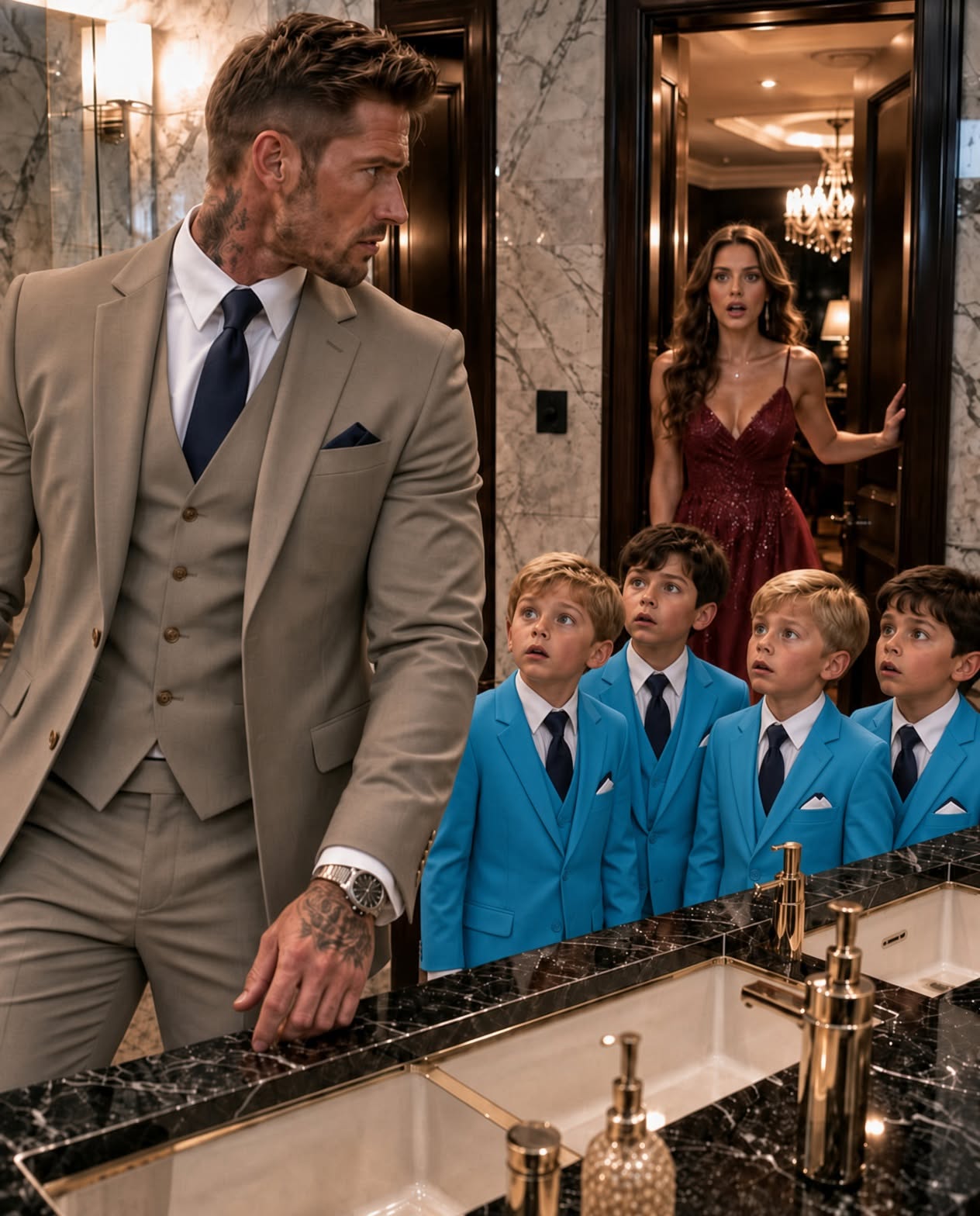
The mirror in the men’s room of Le Cygne was polished twice an hour by staff trained to keep Manhattan’s elite from ever seeing a smudge on their own reflections. It was a massive slab of bevel-edged glass framed in brushed brass, hanging above marble basins that cost more than my first secondhand car. At five o'clock on a freezing Saturday in February, the room smelled faintly of cedarwood soap, eucalyptus oil, and old money.
I stood before it, adjusting the knot of my silk tie for the fourth time.
My black suit had been hand-stitched on Savile Row and flown in via courier three days prior. My grandfather’s platinum cuff links—heavy, cold, and engraved with the Whitaker family crest—pinched the starched white cuffs of my sleeves. In my left interior pocket, nestled inside a velvet box lined with midnight-blue satin, sat a four-carat diamond ring. It had been chosen with the unanimous approval of my mother, our estate attorneys, and a board of family advisors who viewed matrimony not as an affair of the heart, but as a hostile merger of assets with the Cartwright shipping empire.
By seven o’clock, I was expected to step onto the glass-enclosed conservatory overlooking Central Park, smile for the flashbulbs of three dozen society columnists, and slide that ring onto Brielle Cartwright’s finger.
It wasn't love.
It was an acquisition wearing a diamond.
I stared at my reflection. My jaw was tight, carved from the same stubborn granite that had built the Whitaker real estate empire over three generations. My hair was dark, cropped short at the sides, swept back with a practiced casualness that concealed the absolute exhaustion humming beneath my skin.
Then the door swung open, and the illusion of my carefully controlled world shattered into a thousand jagged pieces.
Four little boys marched in line, each wearing an identical navy blue blazer, khaki trousers, and scuffed red sneakers. They couldn't have been older than six. They moved with a synchronized, chaotic energy, scattering toward the four marble basins like a school of small, bright fish.
At first, I barely noticed them. Children of wealthy patrons occasionally wandered into the private dining clubs, lost between the coat check and the private salons. I reached for a paper towel, shaking off the water from my hands.
Then the smallest boy—the one on the far left—pushed his wet hair back from his forehead.
My hand froze halfway to the towel dispenser.
The other three boys copied the gesture in unison.
A slim, pale hand sweeping from the brow to the crown. A slight, unconscious shake of the head to settle the strands. Then the left hand dropping down to touch the back of the neck, right where the hairline met the collar.
It was a tic. A nervous habit. My father used to laugh at it during board meetings when I was twenty, clapping a heavy hand on my shoulder and saying, “That’s how you know a Whitaker man is thinking too hard, Julian.”
I slowly lowered my hands.
The smallest boy caught me staring at him through the grand mirror. His reflection met mine, and for a terrifying, vertigo-inducing second, I felt as though I were looking at four miniature clones of myself refracted through a funhouse glass.
“Mister, why are you copying us?” he asked, his voice bright and entirely unafraid.
“I’m not,” I whispered. The words felt dry, catching in a throat that had suddenly turned to dust.
All five of us—me and the four pint-sized carbon copies—faced the glass.
The same slate-gray eyes, flecked with gold near the pupils.
The same sharp, decisive line of the jaw.
The same faint, asymmetrical dimple in the left cheek that only appeared when we were trying not to smile.
“I’ve always done that,” I said to the glass, my voice barely audible over the hum of the ventilation system.
The boys grinned back, four identical, gap-toothed smiles that hit me like a physical blow to the chest.
“So have we,” the boldest one said, planting his hands on the edge of the sink and standing on his tiptoes. “Mom says it’s our thinking switch.”
My mouth went completely dry. My heart, which had been beating with the slow, steady rhythm of a man about to sign a multi-million-dollar contract, suddenly slammed against my ribs like a trapped bird.
“Where’s your mother?” I asked, my voice cracking slightly.
“She works here,” the boy said, turning around and leaning back against the marble. He held out a hand smaller than my palm. “I’m Milo. That’s Mason, Max, and Micah. We’re quadruplets. Today’s our birthday. We’re six!”
Milo. Mason. Max. Micah.
The names weren't just words; they were anchors dragging up a shipwreck I had spent six years trying to dynamite and bury at the bottom of the ocean.
“Where is she?” I repeated, ignoring the ringing in my ears.
“In the back,” Milo pointed toward the heavy service doors leading to the kitchens and administrative offices. “She’s arguing with the manager because we need somewhere to sleep tonight and he said we have to leave.”
I didn't think. The Savile Row suit, the board meeting at seven, the diamond ring in my pocket, the Cartwright alliance—it all evaporated like steam off a winter sidewalk. I turned on my heel and pushed through the heavy double doors into the labyrinthine service corridors of Le Cygne.
The immaculate white tiles of the dining rooms gave way to scuffed concrete floors, stainless steel prep tables, and the frantic, heat-drenched chaos of a five-star kitchen during the Saturday dinner rush. Cooks barked orders in French and Spanish; line servers rushed past with trays piled high with seared duck and truffle foam.
And there, standing near the delivery entrance beside a towering stack of cardboard recycling bins, stood the manager, Mr. Vance, his face flushed with irritation.
Facing him was a woman in a black server’s apron and a crisp white button-down shirt. Her dark hair was pulled back into a messy bun, escaping strands curling against the nape of her neck.
“I don’t care about your shift, Mara,” Vance was saying, his voice sharp enough to cut glass. “Employees are not allowed to bring their children into the prep areas, and they certainly cannot sleep in the dry-storage lockers. This is a Michelin-rated establishment, not a homeless shelter.”
“My boys only need somewhere safe until midnight,” she pleaded, her voice trembling with a exhaustion so profound it seemed to anchor her to the concrete floor. “My babysitter canceled, and I couldn't afford to lose this shift—if I lose this job, we won't have heat tomorrow—please, Mr. Vance, just twenty minutes until my sister gets off her shift—”
“Not my problem,” Vance snapped, turning his back on her. “Get them out of the service bay by six-thirty, or don't bother coming back on Monday.”
Mara stood frozen, her shoulders slumping as if a heavy weight had just been dropped across them. She closed her eyes, biting her lower lip to keep it from trembling.
Then she opened them and looked up.
Time didn't slow down; it stopped entirely.
The tiny, crescent-shaped scar just above her left eyebrow—a souvenir from a bicycle accident we had shared when we were nineteen.
Those impossible, brilliant green eyes that had haunted every waking hour of my twenties and every cold, empty night of my thirties.
Mara.
The woman I had loved with a fierce, absolute devotion that terrified my mother. The woman who, six years ago, had packed a single duffel bag, cleared her bank accounts, and vanished from my penthouse without leaving a single note, a single text, or a single word of explanation.
The woman my mother had spent three days crying over before handing me a sealed envelope containing a certified letter: “Julian, I never wanted your world. I’m leaving. Don't look for me. Don't come after me. It’s over.”
“Mara…”
My voice was a ragged whisper, dragged out from a place I hadn't visited in years.
She turned her head. Her green eyes locked onto mine across the narrow corridor, past the stainless steel prep tables and the hanging pots.
The color drained entirely from her face, leaving her skin the shade of old paper. She staggered back half a step, her hands flying to her mouth.
“Julian…” she breathed, the name slipping out like a curse or a prayer.
From behind me, the four little boys trotted up, their red sneakers squeaking against the concrete. Milo grabbed the hem of Mara’s apron, looking up at her with big, solemn eyes.
“Mom? Is this the man who was copying us in the mirror?”
Mara looked down at Milo, then back up at me. Her expression shifted from shock to stark, unadulterated panic. Her maternal instincts flared like a shield of fire.
“Boys,” she said, her voice sharp and breathless as she dropped to her knees, gathering all four of them into a tight, protective cluster against her chest. “Get your coats. We’re leaving right now.”
“Mom, it’s freezing outside—!” Mason started to protest.
“Now!” she commanded, her voice breaking.
She stood up, her jaw set, her green eyes blazing with a fierce, defensive fury that reminded me painfully of the girl I had fallen in love with in a cramped apartment above a bookstore in the Village. She grabbed the handles of two worn canvas duffel bags sitting beside the recycling bins.
“Don’t,” I said, stepping forward.
“Stay away from us, Julian,” she hissed, her voice vibrating with a quiet, dangerous intensity. “Don't you dare come near them.”
“Mara, your boys are six years old,” I said, my voice dropping to a low, steady murmur as I closed the distance between us, ignoring the curious glances of two line cooks standing by the fryers. “February in New York. You’re being evicted from the service bay, you have nowhere to sleep, and they have my face.”
“They have nothing to do with you,” she lied, her voice shaking violently as she clutched Milo’s small hand so tightly his knuckles turned white. “They are mine. Only mine.”
“Look at them,” I said, pointing gently toward the boys, who were watching us with wide, curious eyes. “Look at their eyes. Look at the way they stand. You can hide from me, Mara, but you can’t hide genetics.”
“I’m not hiding anything,” she whispered, tears finally spilling over her lashes and cutting tracks through the flour dust on her cheek. “You made your choice six years ago, Julian. You chose the boardroom, you chose your mother’s dynasty, and you chose the life cut out for you by people who looked down on girls like me. Leave us alone.”
“My mother told me you left,” I said, the words tasting like ash in my mouth. “She told me you took a payoff to walk away.”
Mara stopped dead. Her green eyes widened in genuine, unscripted horror.
“What did you say?”
“My mother said you packed your bags because the Whitaker family wasn't ‘suitable’ for an aspiring artist from Brooklyn,” I said, every syllable burning my tongue. “She showed me the letter.”
Mara let out a short, hollow laugh that sounded like glass breaking.
“I never wrote a letter, Julian,” she whispered, her voice dropping so low I had to read her lips. “I didn't take a dime. I woke up in a hospital room in Queens after going into premature labor at twenty-six weeks, and when I asked for you, your mother’s lawyer was sitting in the chair by my bed with a stack of non-disclosure agreements and a ticket out of the state.”
The kitchen around us seemed to vanish. The roar of the exhaust hoods, the clatter of pots, the shouts of the line chefs—it all dissolved into an absolute, ringing silence.
My mother.
The woman who had spent thirty years orchestrating every detail of my existence, who had arranged this very evening’s engagement party in the conservatory, who had hand-picked Brielle Cartwright like a prize heifer for slaughter.
She hadn't just driven Mara away. She had stolen my life, my family, and six years of my children’s existence, packaging the theft in a neat little lie signed with forged ink.
“Mom?” Milo tugged on Mara’s sleeve again, shivering in his navy blazer. “It’s cold. Are we going outside?”
Mara looked down at her sons, her expression breaking into something so achingly vulnerable that it tore open whatever was left of my chest.
I reached into my coat pocket, pulled out the sleek black key card to my Tribeca penthouse—the empty, cavernous five-thousand-square-foot fortress of glass and steel where I slept alone every night—and held it out toward her.
“No questions tonight,” I said, my voice thick with a resolve that felt absolute. “Take the boys. Go to my apartment. There’s food in the fridge, heat in the radiators, and beds that haven't been slept in for a month. Just get them out of this cold.”
Mara stared at the key card lying flat in my palm. She looked at my face—at the jawline, the eyes, the undeniable map of our shared blood etched into the four small faces standing beside her.
For a long moment, I thought she would slap it out of my hand. I thought she would curse me, turn around, and walk out into the blizzard.
Instead, she looked down at Milo, whose lips were turning slightly blue from the draft coming off the alley loading dock.
She snatched the key card from my hand, her fingers brushing against my palm. The jolt of electricity that shot up my arm was identical to the one I had felt seven years ago on a rainy stoop in Greenwich Village.
“This doesn't mean anything, Julian,” she said, her voice hard as iron, though her hands trembled. “You gave us a key because it’s freezing. That’s all. You don’t get to disappear for six years, play the savior for five minutes, and suddenly decide you’re their father.”
The words hit harder than any accusation ever could. They were fair. They were earned.
I looked down at the four boys waiting patiently beside her, their identical slate-gray eyes looking up at me with absolute trust—trust they hadn't yet learned was dangerous to give.
“I’m not deciding anything yet,” I said quietly, stepping back to let them pass toward the service exit. “I’m just trying to understand why they have my face, and why I spent six years living a lie.”
She didn't answer. She grabbed the duffel bags, her arm sweeping around the boys, and ushered them out into the howling February wind.
I stood in the center of the bustling kitchen for three long seconds. The noise rushed back in, deafening and absurd.
I reached into my breast pocket, my fingers brushing against the velvet box containing the four-carat diamond ring meant for Brielle Cartwright. I pulled my hand out, walked over to a stainless steel prep counter, and picked house phone.
I dialed my executive assistant’s direct line. It rang twice before a crisp, professional voice answered.
“Mr. Whitaker? The gallery doors opened ten minutes ago. Your mother is currently greeting the Cartwrights in the conservatory. Everyone is asking when you’ll—'”
“Cancel tonight,” I said.
A pause on the other end of the line. A silence so heavy it felt digital.
“Sir? Cancel... tonight? The engagement announcement?”
“Yes.”
“Mr. Whitaker, your mother is hosting two hundred society guests. The catering alone cost—”
“I don’t care if it cost a million dollars,” I interrupted, my voice dropping into that low, flat register that always made my board members stop arguing. “Tell them I had a medical emergency. Tell them the event is postponed indefinitely.”
“Sir, your mother will—she’ll have a fit—”
“Let her,” I said, and ended the call.
I dropped the phone onto the prep table, sliding it past a pile of chopped parsley.
I didn't yet know whether those four boys were legally, biologically, undeniably mine—though looking at their faces in the mirror had already answered that question in my bones.
May you like


I only knew one thing with absolute, unshakeable clarity:
I would not marry another woman, I would not step foot in my mother’s house, and I would not let another day pass until I tore down every brick of the lie that had stolen my family. And the first person standing in my way was the woman waiting in the conservatory with a glass of champagne and a fabricated smile.


