Chapter 2 - The Glass Tower
The Costa Vanguard Logistics building sat on the edge of the Inner Harbor like a dark, polished monolith designed to remind the city who held the keys to the water.
It wasn't made of red brick or corrugated steel. It was high-efficiency glass and black granite, reflecting the gray, leaden sky of late afternoon and the dark, oily surface of the river.
Frankie parked her 2004 Ford F-250 in the loading zone directly in front of the main entrance. The truck’s left exhaust pipe had a hairline crack near the manifold, producing a distinctive, loud thump-thump-thump that rattled the plate-glass windows of the pristine lobby as she shut off the ignition.
She didn't change her clothes.
She wore her dark canvas work jacket with the embroidered Bellini Auto patch over the left pocket, her oil-stained work jeans, and her Red Wing steel-toed boots, which left two small crescents of dark gray grime on the polished marble floor as she walked through the double doors.
The lobby was vast, silent, and smelled of expensive citrus cleaner and air-conditioned money.
A security guard in a dark blue blazer stepped out from behind a curved black desk. He was broad-shouldered, with a short haircut and the disciplined, heavy-footed gait of an ex-cop.
"Ma'am," he said, holding up a large palm. "Service deliveries are around back on East Pratt. The freight elevator—"
"I'm not a delivery," Frankie said, her voice cutting through the clean air of the lobby like a file across a burr. "I'm here for Gabriel Costa."
The guard’s eyebrows pulled together. He looked down at her stained boots, then up at her grease-marked cheekbone, his expression shifting from routine boredom to mild disgust.
"Mr. Costa doesn't see unscheduled visitors. You need to leave."
Frankie didn't stop walking. She moved past his hip toward the bank of silver elevators at the rear of the foyer.
"Tell him Francesca Bellini is here about the sixty percent of parcel 408 he forgot to buy," she said without turning around.
The guard’s hand came down on her shoulder—heavy, firm, and thoroughly uninvited. "Listen to me, lady—"
Frankie stopped. She didn't flinch, but her head turned slowly, her dark eyes locking onto the guard’s face with a cold, flat intensity that made the man’s grip loosen by a fraction of an inch.
"Take your hand off my jacket," she said softly, "or I will use the three-inch pry bar in my left pocket to unhook your collarbone."
The guard stared at her. He had worked security for four years; he had handled drunks, angry union reps, and process servers. But there was something entirely unhinged about the absolute lack of hesitation in her voice. She wasn't threatening him to sound tough; she was stating a mechanical sequence of events.
He slowly pulled his hand back.
Before he could reach for his radio, the silver elevator doors at the end of the hall slid open with a soft, melodic chime.
A man in a charcoal-gray suit stepped out, holding a thin leather tablet. He looked fifty, with salt-and-pepper hair, rimless glasses, and the cautious, watchful expression of a senior corporate attorney.
"Is there a problem, Marcus?" the lawyer asked.
"She says her name is Bellini," the guard grunted, keeping his eyes on Frankie. "Wants to see the boss."
The lawyer stopped. His eyes scanned Frankie from her steel toes to her dark hair. A tiny, almost imperceptible shift occurred in his expression—the subtle recalculation of a man who dealt in risks and liabilities.
"Francesca Bellini?" he asked.
"Just Frankie," she said. "And unless you're the guy who owns the thirty-foot haulers parked on the pier, you're in my way."
The attorney looked at her for three long seconds. Then he pressed a button on his tablet, tapped the screen twice, and stepped aside, gesturing toward the elevator with an open hand.
"Floor forty," he said smoothly. "Mr. Costa has ten minutes before his board briefing."
Frankie didn't thank him. She stepped into the elevator, the silver doors sliding shut with a quiet, hydraulic hiss that sealed her into a small, mirrored box that smelled faintly of cedar and leather.
As the indicator light climbed—10... 20... 30...—she looked at her reflection in the polished steel wall.
She looked tired. The dark circles under her eyes were purple, her hair was falling out of its knot in wisps, and there was a smudge of carbon on the side of her neck. She looked like a woman who worked for a living in a building where nobody did.
The elevator stopped with a smooth, imperceptible deceleration.
40.
The doors parted.
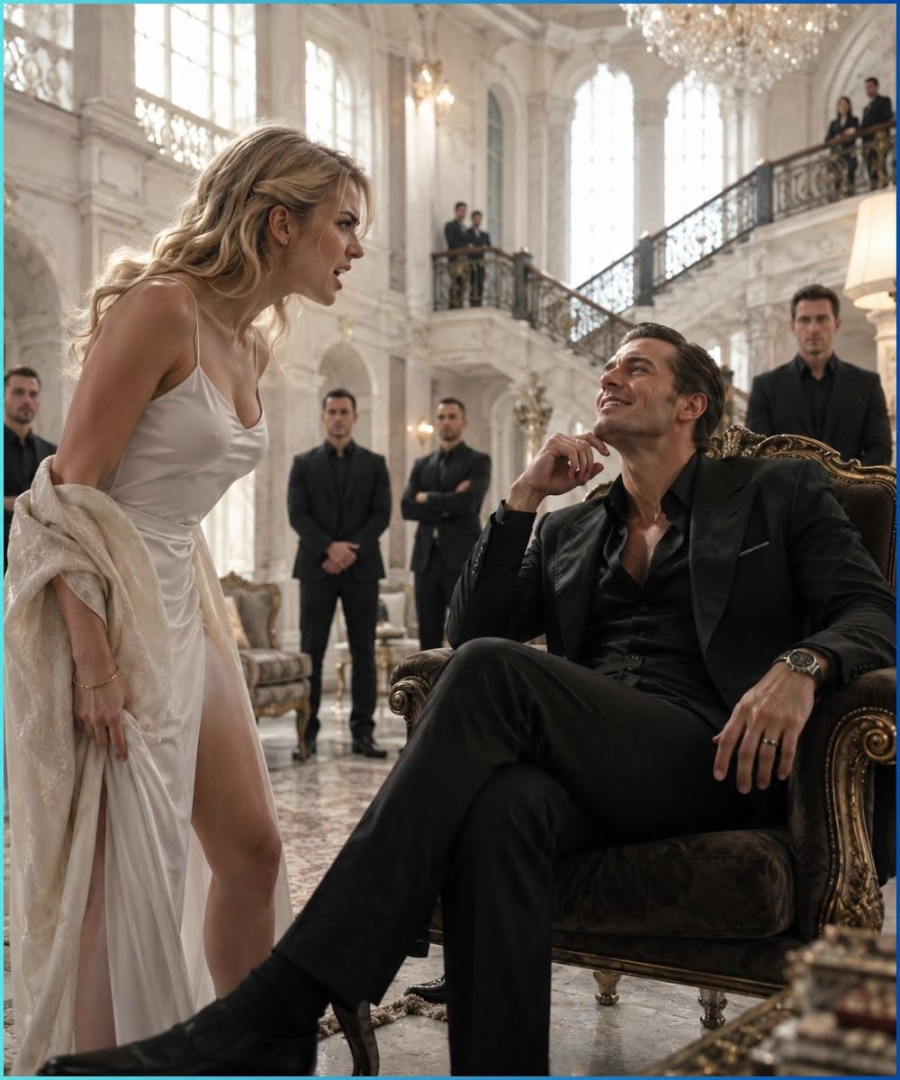
The top floor wasn't an office; it was a cathedral constructed of money and light.
The ceiling was twenty feet high, framed by massive, slanting glass panels that looked out over the entire expanse of the Baltimore harbor. Below, the red-and-white container cranes looked like iron grasshoppers standing in the gray water. The floor was dark, wide-plank walnut, so polished it reflected the clouds outside.
At the far end of the room, behind a massive, seamless desk carved from a single slab of dark gray stone, sat Gabriel Costa.
He was signing documents with a thick, gold fountain pen.
He didn't look up when the elevator opened. He didn't look up as Frankie’s steel-toed boots clicked against the dark wood floor.
There were two other men in the room. They stood near the floor-to-ceiling glass—broad-chested, silent, wearing tailored suits that couldn't quite conceal the heavy bulk under their left arms. Their hands were loosely crossed in front of them, their eyes following Frankie’s progress across the wide floor with the passive, mechanical interest of crows watching an insect.
Frankie stopped five feet from the stone desk.
The silence in the room stretched. Ten seconds. Twenty.
Gabriel Costa kept writing. His hand moved across the heavy paper with smooth, effortless precision, the gold tip of his pen making a tiny, rhythmic scratch-scratch sound that was the only noise in the vast space.
He looked about thirty-eight. His hair was thick, jet-black, and swept back from a sharp, angular forehead. His jaw was dark with three days of carefully maintained stubble, and his nose had a slight, noble crook in the bridge—the mark of a bone that had been broken once, long ago, and set by someone who didn't care about perfection.
He wore a charcoal suit—no tie, the top two buttons of his crisp white shirt unbuttoned, revealing the dark, corded muscles of his throat.
He was, Frankie realized with a sudden, sharp wave of irritation, impossibly handsome in the way dangerous, expensive things usually were.
Finally, he set the pen down into a heavy brass tray.
He slowly capped it. The gold cap clicked into place.
He raised his head.
His eyes were cold, gray-black, and entirely devoid of light—like the deep water under Pier 4 after midnight.
"Francesca Bellini," he said.
His voice wasn't loud, but it had a low, resonant rumble that seemed to settle directly into the floorboards under her feet.
"I expected your brother," he added.
Frankie crossed her arms over her chest, her canvas jacket stiff against her ribs. "I'm not my brother."
"So I've noticed," Costa said. His eyes moved over her face, taking in the grease stain, the messy hair, the dark eyes that refused to drop to the floor. "You smell like gasoline."
"And you smell like a tax dodge," Frankie replied instantly.
Near the window, one of the broad-shouldered men shifted his weight, his coat swinging open half an inch to reveal a dark leather holster.
Gabriel didn't move. He leaned back in his leather chair, resting his forearms on the stone desk, his thick fingers lacing together.
"Your brother owes me three hundred thousand dollars, Ms. Bellini," he said smoothly. "He signed an agreement at two o'clock this morning transferring his interest in parcel 408 to Costa Vanguard Logistics as settlement of that debt."
"Leo owns forty percent," Frankie said, her voice dropping into the same flat, dangerous register she’d used in the shop. "Sixty percent belongs to me. He can't sign over a deed he doesn't hold."
Gabriel tilted his head slightly. "Perhaps he misunderstood his authority."
"He misunderstands instructions printed on microwave dinners," Frankie said. "That doesn't give you the right to steal my property."
A tiny, almost imperceptible shift occurred in Gabriel’s face. The corner of his left eyebrow rose a millimeter.
Near the window, the second guard let out a tiny, stifled breath that might have been a snort. Gabriel didn't look at him, but the guard instantly froze, his face returning to stone.
"Your brother used the garage as collateral for a high-stakes credit line," Gabriel said, his tone as even as an account ledger. "In my world, when collateral fails to clear, we take the physical asset."
"In my world," Frankie countered, taking a step closer to the desk until the toes of her boots brushed the stone base, "when a rat sneaks into your house and signs your name on a piece of paper, you don't give him the keys. You trap the rat."
"And what do you do to the man who gave the rat the paper?" Gabriel asked softly.
May you like


Frankie stared into his gray-black eyes.
"You tell him no," she said.


