Chapter 2 - THE ANATOMY OF A HEIRLOOM FRAUD
By 7:42 a.m. the next morning, the sun was trying to punch through a heavy layer of grey New York fog, casting a pale, jaundiced light across my apartment kitchen. My laundry was neatly folded in a plastic basket by the door—scrubs on the bottom, socks and underwear rolled tight on top.
I sat at the small laminate kitchen table with my laptop open, a cold cup of instant coffee sitting beside a stack of credit bureau printouts that looked like a death certificate for my financial future.
I pulled my credit reports from all three major bureaus: Equifax, Experian, TransUnion.
My credit score—which had sat comfortably at a respectable 740 for a decade, earned through years of paying off student loans thirty days early, carrying zero credit card debt, and never missing a utility bill—had plummeted.
546.
I stared at the red number on the screen until the pixels blurred into a smear of crimson.
According to the reports, I wasn't just three months behind on a jumbo mortgage in Westchester County. I also had two maxed-out store credit cards from luxury boutiques on Madison Avenue, an auto loan for a 2025 BMW X5 registered in my name, and a personal line of credit totaling forty-five thousand dollars—all opened within a three-week window in January.
Amanda had didn't just buy a house with my name. She had outfitted the entire lifestyle. She had built a luxurious, glittering facade on top of my credit history like someone constructing a mansion on top of an old minefield, knowing full well that when it collapsed, I would be the one buried in the debris.
I wanted to call her. God, I wanted to pick up the phone, dial her cell, and scream until my vocal cords shredded. I wanted to hear her stutter, to hear her try to spin some magnificent, golden-tongued excuse about how it was all a misunderstanding, how she just needed a temporary bridge loan until Brian’s startup went public, how family helps family.
But I knew Amanda too well.
She was an artist of manipulation. She could lie with her hand resting warmly on your arm. She could look you dead in the eye with tears welling in those bright green eyes and make you feel like you were the unreasonable one for questioning her integrity. She had done it our entire lives—turning our parents against my protests, rewriting history until she was always the golden martyr and I was the bitter, difficult younger sister.
If I confronted her without an airtight case, she would twist it. She would cry to our mother that I was jealous of her success, that I was unstable, that I was fabricating stories out of spite.
So I didn't call her. Instead, I gathered proof.
At 10:00 a.m., I sat across the desk from Diane Vance, a certified financial adviser whose office smelled of expensive parchment paper and peppermint tea. A small American flag stood upright beside a framed photograph of her grandchildren on the shelf behind her.
She flipped through the mortgage packet and the credit printouts, her glasses sliding down the bridge of her nose.
When she reached the page listing 4872 Highland Drive, she stopped. She looked up at me, her expression shifting from professional detachment to deep, human distress.
“This is identity theft of the highest order,” Diane said, her voice dropping. Then she looked closer at the property address. “Wait... is this your sister’s house?”
“Yes,” I said flatly.
Diane closed the folder gently, as if handling radioactive material. “Family fraud is emotionally devastating, Miss Wilson. People assume fraud always comes from strangers in Eastern Europe or skimming devices at gas stations. But identity theft within families is more common than anyone admits—and infinitely more vicious, because the perpetrator already has your social security card, your birth certificate, and your trust.”
“What do I do?”
“Legally? Without an official police report and a sworn affidavit of forgery, the banks will treat you as a co-conspirator or a willing participant who buyer’s-remorse-backed out of a bad deal. You aren't just a victim yet, legally speaking. You’re a liability.”
Victim.
I hated that word. It made me feel like I had left a door unlocked in my own house, inviting a burglar in while I was asleep.
From Diane’s office, I drove straight to a forensic document examiner recommended by the bank’s legal liaison—a retired NYPD investigator named Marcus Bell who operated out of a cluttered second-floor office in lower Manhattan.
Marcus had thick white hair, tired eyes behind bifocals, and a magnifying glass resting on a desk littered with old handwriting exemplars from high-profile embezzlement cases in the nineties.
He spent forty-five minutes examining the mortgage documents side-by-side with my actual passport, my hospital employment contract, and my apartment lease. He used a digital microscope to inspect the stroke velocity, the pen lift patterns, and the baseline alignment of the ink.
Finally, he leaned back in his leather chair and looked at me over the top of his glasses.
“These are forgeries,” he said simply.
“Are you sure?” I asked, my breath catching. “Bank managers thought they looked authentic.”
“Bank managers look at numbers, not micro-movements,” Marcus said, tapping his finger against the digital scan of the signature on the promissory note. “Look right here, at the loop of the R in Wilson. See how the pen hesitates for a microsecond before completing the downstroke? That’s not natural handwriting flow. That’s a hesitation mark. Someone was tracing over a template or carefully copying from an original document.”
He pointed to another section.
“And the pressure points are all wrong. A natural signature has variable pressure—heavier on the downstrokes, lighter on the ascenders. This signature has uniform, forced pressure throughout, like someone drawing a picture of a signature rather than actually signing their name.”
He leaned forward, his old eyes sharp and assessing. “Whoever did this knew your signature well enough to know the basic shape, but they were nervous. They practiced. Probably dozens of times on scrap paper before they got it onto the official digital pad or the physical paper.”
I didn't ask who. I didn't need to. There was only one person in this city who had ever watched me sign documents, who had access to my old tax returns from when we shared an accountant three years ago, and who possessed the cold, calculating ambition to pull it off.
By Friday afternoon, I had my evidence weaponized.
I had the complete mortgage packet with the forged signatures. I had the credit reports showing the wreckage of my financial life. I had Marcus Bell’s formal forensic handwriting analysis report, signed and notarized, declaring the signatures to be fraudulent. And I had the police report filed at the 19th Precinct earlier that morning—a formal complaint of identity theft and aggravated forgery against an unspecified party, stamped with an official shield number by a tired-looking detective named Miller who had barely looked up from his turkey sandwich when I handed him the file.
My hands shook so badly as I signed the precinct paperwork that the desk sergeant had to push a cup of lukewarm tap water across the counter toward me and tell me to breathe.
“Take it easy, nurse,” he had said kindly. “Family stuff gets ugly. We see it every day.”
That night was the bi-weekly family dinner at my parents’ house in Queens.
Every other Friday, my mother expected us to gather around the dining table for her legendary homemade lasagna, garlic bread, and awkward small talk about weather, real estate, and my unmarried status. It was an institution as old and unyielding as the Catholic church.
I parked my dented Honda three blocks away because I didn't want my father making passive-aggressive comments about my transmission leaks.
When I walked up the front steps of the suburban split-level house where we grew up, the warm, rich scent of baked mozzarella and oregano spilled out through the front door. I could hear my father’s low rumble of laughter in the den and my mother’s voice trilling about some neighborhood gossip.
I stood on the porch for ten seconds, taking a deep breath of the freezing February air, letting the cold harden the edges of my soul until nothing was left inside me except glass and steel.
I pushed the door open.
“Heather!” my mother called out from the kitchen, wiping her hands on a floral apron. “Wash your hands, honey, we’re about to sit down. Your sister and Brian just got here ten minutes ago.”
My sister.
Amanda came out of the kitchen hallway carrying a platter of warm garlic bread, looking like an advertisement for a suburban lifestyle magazine. She wore a cream-colored silk blouse that caught the dining room light, her dark hair swept back in a loose, elegant clip, her skin glowing with that effortless, expensive radiance that came from never having to worry about an overdraft fee or a double shift.
Behind her strolled Brian, loosening his silk tie, smelling faintly of Tom Ford cologne and scotch.
“Hey, kiddo,” Amanda greeted me, leaning in to brush her cheek against mine with practiced sisterly affection. Her skin smelled of expensive jasmine perfume. “You look exhausted. Did you pick up another double shift at the hospital? Honestly, Heather, you really need to learn how to set boundaries at work. You’re going to burn yourself out before you're thirty.”
“I’m fine, Amanda,” I said, pulling back. My voice was too calm. Too flat.
She didn't notice. People wrapped up in their own perfection rarely notice when other people stop playing along.
We sat down around the heavy oak dining table.
My father carved the lasagna while my mother fussed over the salad bowls, chattering away about my cousin’s new job in insurance and how expensive heating oil had become this winter. Brian poured red wine into crystal glasses, stopping to fill Amanda’s glass first with a fond, indulgent smile.
Everybody acted normal.
That was the cruelest, most sickening part of it all.
Normal sat at the table with us. Normal passed the garlic bread. Normal laughed when Amanda told an amusing little anecdote about how a contractor had messed up the custom built-in bookshelves in the library at Highland Drive, forcing them to delay their interior designer’s grand reveal by a whole week.
“It was just a nightmare,” Amanda sighed, rolling her eyes playfully as she forked a piece of lasagna. “You simply cannot find good help these days. People just don't want to work with any level of precision anymore.”
I sat directly across from her.
My fork rested beside my untouched plate. My mother noticed immediately.
“Heather? Aren't you hungry? You love my lasagna.”
“I’m fine, Mom,” I said quietly.
Forks scraped against ceramic plates. The brass ceiling fan turned in slow, rhythmic circles overhead, clicking once every four rotations. Tomato sauce steamed between us under the warm glow of the chandelier. My father stared intently at his napkin when Amanda bragged about their second-floor balcony. My mother kept nervously refilling water glasses that nobody had asked for. Brian leaned back in his chair, swirling his red wine like a man who believed money trouble was weather that only happened to other people in other zip codes.
Then Amanda lifted her wineglass, took a delicate sip, and smiled down the table at me with an expression of patronizing, sisterly pity.
“You know, Heather,” she said, her voice carrying that light, musical tone that used to make me feel small when we were kids. “People who play small stay small. You really ought to take a risk for once in your life. Stop renting that tiny box in Astoria. Put down roots. Buy a real home. It changes your whole perspective on what’s possible.”
The silence in the room dropped like an anvil.
My mother stopped mid-sentence about my cousin’s insurance job. My father’s fork froze two inches from his mouth. Brian’s wineglass paused halfway to his lower lip.
I didn't answer right away.
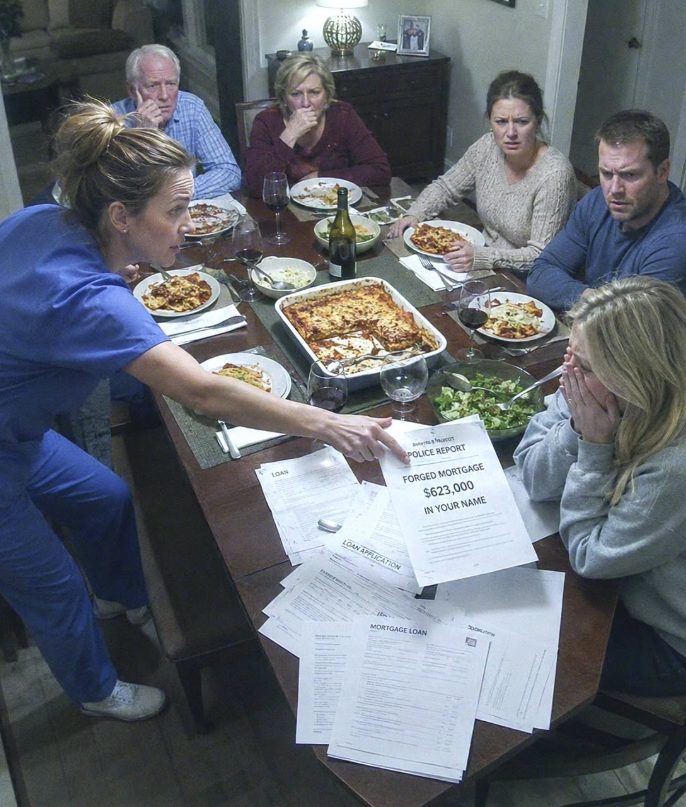
I reached slowly into the structured leather tote bag resting on the floor beside my chair. My fingers found the cold, heavy manila folder—the one containing the bank records, the forensic handwriting analysis, the credit reports, and the police report stamped by the 19th Precinct.
For one ugly, scorching second, I pictured standing up, screaming at the top of my lungs, and letting every drop of poison in my veins spill out across the table. I pictured the crystal wineglass in Amanda’s hand shattering against the floor. I pictured my mother finally looking at both of her daughters with clear eyes instead of lifetime favoritism.
I didn't scream. I didn't throw anything.
With slow, deliberate movements, I pulled the thick manila folder from my bag, laid it flat upon the polished oak table, and slid it across the lasagna, past the garlic bread basket, past my mother’s trembling hand, until it bumped softly against the rim of Amanda’s white ceramic plate.
The room went absolute, terrifyingly dead.
The ceiling fan clicked. Click.
My father’s fork clattered against his plate.
Amanda looked down at the folder. Her eyes scanned the bold black lettering stamped across the front cover by the bank’s legal department, and then drifted down to the police report header visible through the transparent plastic sleeve.
The color drained from her face so fast it was as if someone had pulled a plug at the base of her neck. Her skin turned the greyish-white of skim milk.
Brian reached out across the table, his fingers brushing the corner of the folder. “What is this?” he asked, frowning.
Before his fingers could touch it, Amanda’s hand shot out with terrifying speed and grabbed his wrist, gripping it so hard her knuckles turned yellow.
My mother’s voice came out as a thin, trembling whistle.
“Heather... what is this?”
May you like


I looked across the table at my sister. The woman who had stolen my name, my credit, my future, and my peace of mind, sitting there in her expensive silk blouse with six hundred thousand dollars of debt tied around my neck.
I leaned forward, resting my forearms on the edge of the table, and said—


