Chapter 1 - THE PNEUMATIC RATTLE AND THE 6:18 P.M. EXECUTION
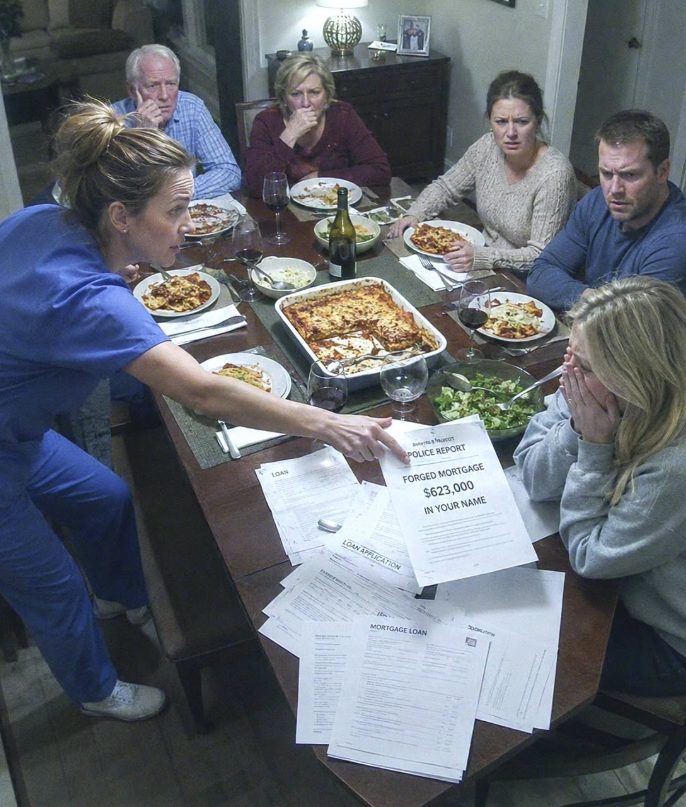
The hospital floor always smelled of bleach, damp linoleum, and the quiet, desperate despair of people waiting for lab results. In Room 214, the seven-year-old boy named Tyler was blinking hard against the sting of antiseptic while I taped down a fresh gauze pad over his IV line. The pediatric wing at St. Jude’s was supposed to be a place of healing, but tonight it felt like an airlock holding back an infinite expanse of cold space. My scrub sleeves were rolled up past my elbows, revealing skin that had been scrubbed raw with antibacterial soap three times before my shift even began.
My phone, tucked securely into the pocket of my scrub pants, vibrated.
It wasn't a standard ring. I kept it on silent because nurses learn early that ringing phones in a hospital usually mean panic. But the vibration had a different cadence—sharp, rhythmic, and heavy. I didn't answer it immediately. My thumb was still sticky from the medical adhesive, and Tyler’s mother was standing by the window, her knuckles white as she watched the sleet slicking the windowpanes outside.
“You're doing great, buddy,” I told Tyler, smoothing the edge of the tape. “No video games for an hour, but you can have that cherry Popsicle you were begging for.”
He managed a weak, brave little grin.
I stepped out into the hallway, pulling the door half-shut. The fluorescent lights overhead hummed with a low, miserable frequency. I pulled the phone from my pocket, expecting a text from the charge nurse about a bed shortage on the third floor or a reminder from my landlord about the trash bins.
Instead, I saw an unknown number with a local area code.
“Heather Wilson?” a voice asked. It didn't sound angry, which somehow made it worse. It sounded like a man who spent his life reading scripts from laminated cards in rooms with low ceilings and bad air conditioning.
“Yes,” I said, leaning my shoulder against the cool cinder-block wall outside Room 214. “This is Heather.”
“Miss Wilson, my name is Craig Donovan. I’m calling from First Liberty Bank’s mortgage default and collections division. I’m reaching out regarding your account ending in 4092.”
I gave a short, breathy laugh—the kind of nervous chuckle that slips out when someone tells a bad joke in an elevator. “I think you have the wrong person, Mr. Donovan. I don't have an account ending in 4092. I rent a one-bedroom walk-up in Astoria, and my checking account has a balance that makes grocery shopping an extreme sport.”
There was a dry rustle of paper on the other end of the line. A keyboard clicked—the sharp, deliberate clatter of a loan officer entering data into an archaic system.
“Our records indicate that you are the primary borrower on a conventional thirty-year mortgage executed on January 14th of this year,” Craig said, his tone entirely devoid of irony. “The principal balance is six hundred and twenty-three thousand dollars. You are currently ninety-two days delinquent on your third consecutive monthly payment.”
The linoleum floor beneath my orthotic sneakers seemed to tilt, as if the hospital had suddenly drifted out to sea. My fingers tightened around the black plastic casing of the phone so hard my knuckles ached.
“I don’t own a house,” I said, my voice dropping an octave, slipping into the flat, clinical register I used when patients tried to deny they were having chest pains. “I have never owned a house. I lived in a university dorm, then a studio in Brooklyn, and now an apartment where the radiator clanks until three in the morning. You have the wrong Heather Wilson.”
“Date of birth?” he asked smoothly.
I told him.
“Social Security number?”
I gave him the nine digits I had memorized when I got my first job at sixteen bagging groceries at the local supermarket.
A pause. A longer click of keys.
“That matches our file, Miss Wilson,” Craig said. “Along with your employment history as a registered nurse at St. Jude’s Medical Center, your past two years of W-2 statements, and your verified income of one hundred and ninety-two thousand dollars annually.”
I let out a sound that wasn't a laugh and wasn't a cry—just a sharp intake of oxygen that burned my throat.
“I make sixty-eight thousand dollars a year before taxes,” I whispered, the words tasting like copper. “If I made one hundred and ninety-two thousand, I wouldn't be wearing scrubs that have been mended twice at the seam.”
“Well, according to the employment verification documents signed by your employer’s HR department and stamped with a corporate seal,” Craig continued, his voice like sandpaper rubbing against wood, “you applied for a jumbo residential loan in January to purchase a property located at 4872 Highland Drive.”
The name of the street hit me like a physical blow to the stomach.
4872 Highland Drive.
The address lived in my head as clearly as my own phone number. It was Amanda’s address. My sister’s address. The magnificent, sun-drenched Craftsman house perched on the edge of the historic district, featuring a wraparound porch, custom Marvin windows, three decorative fireplaces, and a view of the city skyline that could make a saint weep with envy.
Eight months ago, Amanda had invited me over for what she called a “sisterly Sunday.” She had poured me a glass of expensive pinot noir in a crystal stemware glass that felt impossibly fragile between my fingers. She had walked me through every square foot of the place—from the imported Italian marble countertops in the kitchen to the master bathroom with its freestanding soaking tub and heated tile floors.
“Someday you’ll have something like this too, Heather,” she had said, her green eyes sparkling with that effortless, radiant confidence she had worn like a tailored coat since we were children. “You just need to aim higher. Stop letting the hospital grind you down for pennies. You have to think like a winner.”
I had smiled then. I had felt a small, familiar twinge of inadequacy—the lifelong shadow of being the younger sister who studied late, worked double shifts, and drove a dented Honda Civic while Amanda floated through life like she owned the sky. But I loved her. She was my sister. I told myself her arrogance was just her way of pushing me to do better.
I did not know she had already aimed at me.
“Miss Wilson?” Craig’s voice broke through the roaring in my ears. “Are you still there?”
“I’m here,” I choked out.
“Because of the severity of the default, the bank has initiated pre-foreclosure counseling protocols. If the arrears of fourteen thousand four hundred dollars are not paid within fifteen business days, the property will be scheduled for a trustee’s sale.”
“That house is not mine,” I said, my voice shaking so badly I could barely form the consonants. “It belongs to my sister. Amanda Wilson—well, Amanda Miller now. Her husband is Brian Miller. They live there. They moved in last winter.”
Another pause. The rustle of paper.
“Property records for 4872 Highland Drive list the deed holder as Heather R. Wilson,” Craig stated calmly. “Sole ownership. No co-signers. No secondary liens. Executed via electronic signature and notarized by a mobile notary service on January 12th.”
January 12th.
The weekend I had been working a seventy-two-hour stretch during the horrific influenza outbreak, sleeping on a cot in the hospital basement with a rolled-up towel for a pillow.
“Send me the file,” I whispered. “Send every single page to my email right now.”
“I can transmit the digital closing packet to your verified address immediately, Miss Wilson. But I must remind you—debt collection on a fraudulent mortgage requires immediate legal notification. If you are claiming identity theft, you will need to file a police report within forty-eight hours, or our legal department will move forward with asset attachment and wage garnishment proceedings against your primary bank accounts.”
“Send it,” I repeated, and hung up before he could say another word.
I stood in the hallway of the pediatric ward for a long time, staring at the green plastic casing of my phone as if it were a venomous snake. The monitor in Room 214 kept up its soft, rhythmic beep—beep... beep... beep—reminding me that time was moving forward even though my own life had just derailed entirely.
By 6:18 p.m., I had clocked out, pulled my heavy wool coat over my scrubs, and driven my dented Civic through the sleet-slicked streets of the city directly to the downtown branch of First Liberty Bank.
The lobby was already closed to the general public, but a security guard at the side entrance recognized the desperate, hollow look in my eyes—or perhaps he just saw my hospital ID badge hanging from my collar—and let me through to the executive offices.
Richard Peterson, the branch manager, was a man in his late fifties with silver-rimmed glasses and a tie that looked like it had been bought in 1994. He led me into a small, windowless consultation room that smelled of stale coffee and expensive wood polish.
He didn't offer me coffee. He just slid a thick manila folder across the mahogany table.
It was too thick. A normal folder for a bank visit should have been thin. This one looked like a brick.
“I pulled the entire origination file from our regional database,” Richard said, his voice quiet, almost compassionate in a practiced, corporate way. “Miss Wilson... I am sorry you’re dealing with this. This is... well, it’s extraordinary.”
I opened the folder with fingers that felt like frozen wood.
Loan application. Form 1003. Credit authorization. Closing statements. HUD-1 settlement forms. Income verification documents. Page after page after page. My name typed neatly at the top of every single sheet in clean, modern font. My Social Security number. My former address in Astoria. My employer’s tax ID.
And at the bottom of every crucial document—the promissory note, the deed of trust, the Truth in Lending disclosure—was my signature.
Heather R. Wilson.
I stared at the ink.
At first glance, it looked like mine. The sweeping loops, the sharp cross of the t’s, the erratic slant. But the longer I looked, the more wrong it felt, like a portrait painted by someone who had only ever heard a description of my face.
The H was too controlled, too symmetrical. My real H always leaned backward when I was rushed, and I was always rushed. The W was too careful, the loops formed with a deliberate, painstaking slowness that I never possessed. My signature gets loose and jagged in the middle, a chaotic scowl of ink scribbled on insurance forms and prescription pads when thirty patients are waiting in the triage queue.
This signature had been practiced. Rehearsed over and over in a quiet room until the counterfeiter could trace it without trembling.
That was when the last little part of me that had been hoping for a clerical error—a computer glitch, a transposed digit, a bureaucratic mix-up—went entirely, permanently cold.
Amanda hadn't borrowed my sweater. She hadn't borrowed my car keys for a weekend trip to the Hamptons or asked for twenty dollars to cover brunch until payday.
She had stolen my entire financial existence. She had taken my identity, hollowed it out like a pumpkin, and used it as a human shield to buy a six-hundred-thousand-dollar dream home while leaving me holding a mortgage bomb with a live detonator.
Richard leaned forward, resting his elbows on the table. “If you did not sign these documents, Miss Wilson, this is not a civil dispute. This is felony bank fraud and identity theft. You need to contact the police immediately.”
Police.
The word tasted like ash.
In my family, you didn't call the police on your own blood. You didn't air dirty laundry outside the dining room. My mother had raised us with a strict, unspoken code: family problems stay at the family table. Smile through the friction. Keep it private. Don't embarrass your mother in front of her bridge club. Don't make Thanksgiving awkward. Don't cause a scene.
For twenty-eight years, I had followed that rule. I had swallowed my tongue when Amanda took credit for my college scholarship essays. I had smiled when she married Brian—a man who wore expensive loafers and talked about venture capital while looking through people like they were glass—and pretended I wasn't secretly relieved I wouldn't have to watch her break his heart.
I had kept the peace.
I looked down at the forged signature on the loan document, then up at Richard Peterson’s sympathetic, professional eyes.
A forged signature does not become less criminal because it shares your last name.
“I need copies of everything,” I said, my voice level, stripped of all emotion. “Every page. Every IP address from the electronic signatures. Every wire transfer record.”
Richard nodded slowly, opened a drawer, and handed me a duplicate set of files in a clean white envelope.
“I’m sorry, Miss Wilson,” he repeated softly. “Good luck.”
I walked out of the bank into the freezing sleet. The city lights were blurring into long streaks of yellow and red against the wet pavement. I didn't cry. Nurses don't have time for tears during a shift, and apparently, we don't have time for them when our entire lives are stolen either.
May you like


I got into my dented Honda, locked the doors, and placed the white envelope on the passenger seat.
The war had started. And Amanda didn't even know I was holding the ammunition.


