Chapter 1 - THE BLOOD ON THE WHITE ROSE
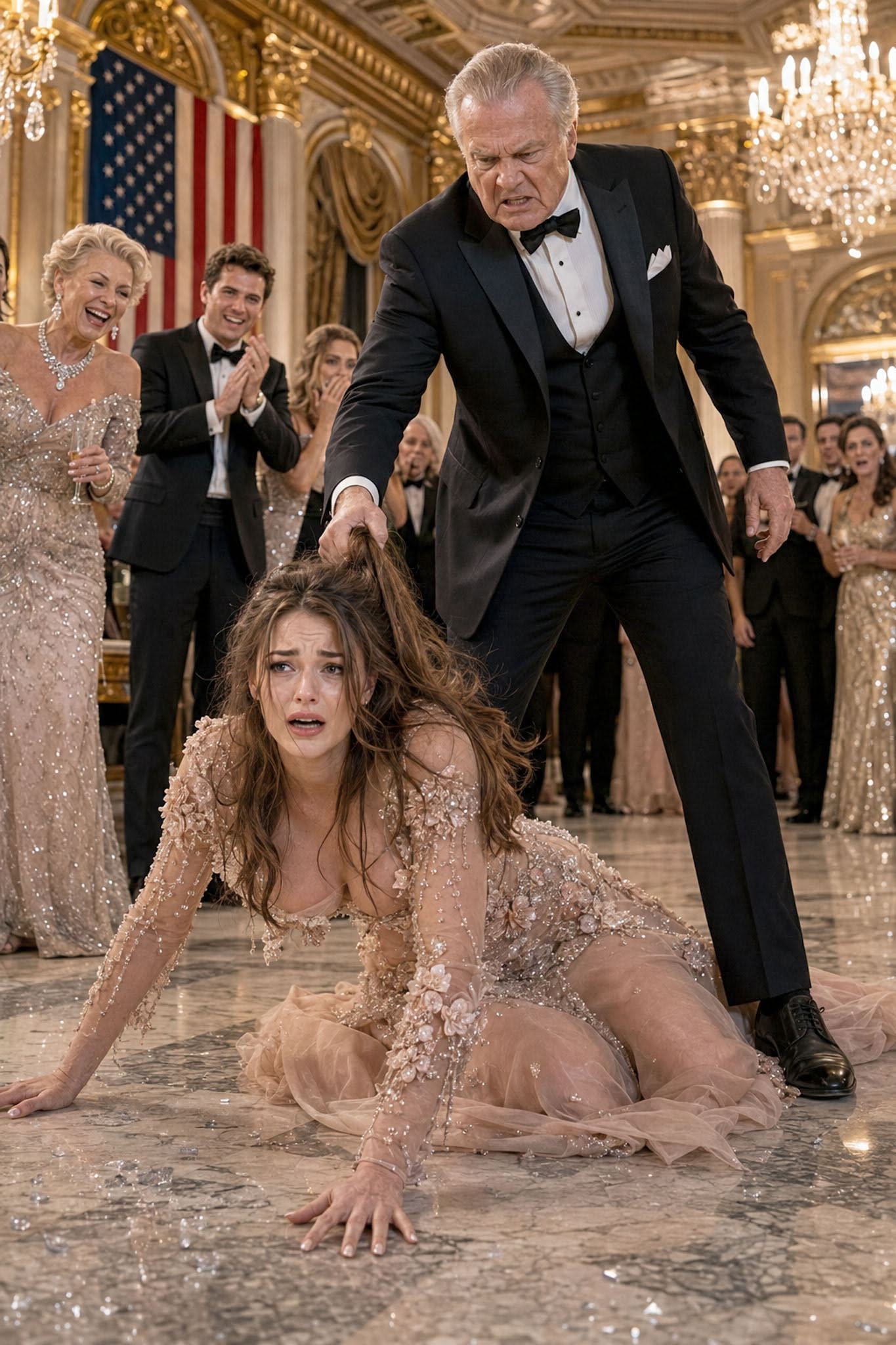
The marble floor of the Grand Monarch Hotel ballroom was polished to a mirror shine, reflecting the warm, golden glow of three massive crystal chandeliers.
Eighty-six people sat at round tables covered in heavy ivory linen. A retired senator from Fort Worth sat near the front. Two three-star Air Force generals in dark blue dress uniforms laughed over glasses of scotch. Three senior vice presidents from Lockheed Martin and Raytheon discussed defense subcontracts in quiet, authoritative tones. A local television anchor adjusted her diamond necklace. The rest of the room was filled with the cream of Dallas society—oil heirs, real estate moguls, and women whose diamond bracelets clinked softly against fine china.
And right in the middle of Table Four, a single white rose centerpiece sat in a crystal vase.
Then my father hit me.
The impact was not a slap. It was a closed-fist blow, backed by two hundred and ten pounds of weight and sixty-eight years of unyielding authority. The crack of bone echoed off the high ceiling like a gunshot.
My face snapped left. Pain, sharp and blinding, tore through my jaw and cheekbone. My body spun, my hip slamming hard against the edge of the table. The crystal vase wobbled, tipped, and shattered.
I landed on my knees. Warm liquid flooded my mouth immediately—salty, metallic, heavy. I gasped, coughing, and a bright red splatter painted the pristine white petals of the rose lying on the linen.
For three seconds, the entire room went dead silent.
The clinking of silverware stopped. The quiet hum of air conditioning suddenly sounded like a roar. Nobody moved. Nobody breathed.
Then my younger brother, Nathan, lifted his champagne glass, took a slow sip, and smiled.
“About time,” he whispered.
The words were quiet, but in the suffocating silence of the ballroom, they carried like thunder.
That was the exact moment thirty-five years of delusion evaporated. I didn't care about the pain radiating through my left eye socket. I didn't care about the warm blood dripping onto my dark green dress. Sitting on the floor of the Grand Monarch, looking up at the polished leather shoes of the men around me, I finally understood the fundamental truth of my life: My family had never wanted a daughter. They had wanted a punching bag. They had wanted a scapegoat.
My name is Evelyn Halden. I was thirty-five years old the night my father fractured my cheekbone in front of the Dallas elite.
My brother, Nathan, was twenty-nine. He was six-foot-two, with our mother’s striking blue eyes, a jawline carved from marble, and a smile that convinced people he was incapable of deceit. Nathan was the golden child. The miracle. The youngest captain in his wing to receive a prestigious new posting overseeing logistics and procurement at the Pentagon.
Our parents’ four-million-dollar mansion in Highland Park was a shrine to Nathan. Framed photographs lined the grand mahogany staircase: Nathan in his Little League uniform holding a trophy; Nathan at his West Point graduation; Nathan shaking hands with a governor; Nathan standing proudly beside his jet.
In that entire seven-thousand-square-foot house, there was exactly one photograph of me.
It hung in the back corridor near the laundry room, framed in cheap plastic. I was nine years old, standing off to the side at Nathan’s fifth birthday party, holding a paper plate of half-eaten cake. My mother had once casually told a friend at a luncheon that I was only in the photo because nobody knew how to crop people out of film prints in 2000. She had laughed when she said it. Nathan had laughed too.
I had spent my entire adult life trying to buy my way out of their shadows. I didn't ask them for a dime after my twenty-first birthday. I worked thirty hours a week while earning my degree in interior architecture at the University of Texas. I lived in a modest twelve-hundred-square-foot apartment in East Dallas. I built my own small business, Halden Interiors, design project by design project. Some months were lucrative; some months I survived on peanut butter and cheap soup.
My parents told everyone in their social circle that I was "financially reckless" and "unstable." They claimed my modest lifestyle was proof of my poor life choices, conveniently omitting the fact that they hadn't contributed a single dollar to my rent, my tuition, or my business since I left home.
I shouldn't have gone to the gala.
I had stood in my bedroom two hours earlier, staring at the dark green silk dress hanging on my closet door. It had cost $240 at a boutique in NorthPark Center. For my mother, $240 was tip money for her hair colorist. For me, it was the exact amount I needed to replace the dying hard drive on my rendering computer. But I had bought it anyway. I had told myself that maybe, just maybe, if I showed up looking professional, polished, and supportive, my father would look at me without contempt.
I drove my ten-year-old Honda Civic downtown, parking it three blocks away because I didn't want the valet to park it between the McLarens and Audis filling the hotel driveway.
When I entered the Grand Monarch’s atrium, my mother saw me first.
Diane Halden was a master of aristocratic disdain. At sixty-two, her hair was a sculpted helmet of silver-blonde, her throat draped in three strands of Mikimoto pearls. She wore a champagne silk gown that cost more than my first car.
“You came,” she said, her blue eyes sweeping over me. She didn't say You look nice. She didn't say I'm glad you're here. She spoke with the mild annoyance of someone discovering a stray hair on their cashmere coat.
“I brought Nathan something,” I said, holding up a small gift bag containing a bottle of small-batch Kentucky bourbon.
She looked at the bag, then down at my dress. “Try not to make tonight about you, Evelyn.”
“I’m just here to congratulate him, Mom.”
Nathan appeared behind her, looking striking in his mess dress uniform, gold braid gleaming on his shoulders.
“Evie,” he said, leaning down to kiss the air an inch from my ear. “You look tired. Are those dark circles, or is the lighting just bad over by the entrance?”
“It’s good to see you too, Nathan. Congratulations.”
He smirked, swirling his scotch. “Don't look so bitter. Not everyone can be built for greatness. Some people are just meant to fill the seats.”
Dinner started at seven-thirty. I was placed at Table Eleven, tucked near the kitchen doors behind a large decorative fern. My parents and Nathan sat at Table One, surrounded by defense executives and politicians.
At nine o'clock, the speeches began.
Nathan spoke first, delivering a polished, charming speech praising his mentors, the Air Force, and his parents. He thanked the waitstaff. He thanked his commanding officer. He did not mention my name once.
Then my father took the stage.
Richard Halden was sixty-eight, six-foot-three, with thick grey hair and the posture of a man who owned everything he looked at. Halden Aeronautics was his pride and joy—a firm that specialized in guidance systems and drone components, heavily reliant on government contracts.
“People ask me how Diane and I raised a son like Nathan,” Richard’s voice boomed through the speakers. Loud applause followed.
He pointed at Nathan, smiling proudly. “You give a child standards. Discipline. Absolute accountability. You teach them that excuses are for failures.”
His eyes drifted across the room, locking onto me sitting near the kitchen doors.
“And when you have one child who refuses to live up to those values,” Richard continued, his tone turning sharp, “you make sure the other child learns from that tragic negative example.”
A few scattered laughs broke out from guests who assumed it was a joke. My stomach turned to ice.
“Fortunately,” my father said, “Nathan understood that success is a choice. He didn't waste his life pursuing silly hobbies or crying about how hard the world is.”
I felt the eyes of the people at my table shift toward me. The woman beside me—the wife of a local real estate developer—looked away in uncomfortable silence.
Something inside me snapped.
It wasn't a sudden explosion. It was the quiet, cold realization that no matter what I did, no matter how quiet I stayed, these people would use me as a prop in their sick family theater forever.
I picked up my clutch bag and stood up.
My mother saw me immediately from the head table. “Evelyn,” she called out, her voice slicing through the applause. “Sit down.”
I stopped. The room began to quiet.
“I came to celebrate Nathan,” I said, keeping my voice level, though my hands were shaking. “I didn't come to be your punchline, Dad.”
My father lowered the microphone. The smile vanished from his face, replaced by a dark, terrifying red flush that I knew all too well from my childhood.
“Sit down right now, Evelyn,” he commanded into the live microphone.
“No,” I said.
My mother gasped softly. Nathan’s eyes narrowed.
“Don't embarrass us,” my mother hissed from her seat, leaning forward.
“You’re doing a fine job of that yourselves,” I replied.
Nathan stepped down from the stage, walking toward me with a smug, condescending look. “Jesus, Evie. Can’t you let me have one night without throwing a dramatic tantrum? You’ve been leeching off this family your entire life. The least you can do is shut up and sit down.”
I stared at him. “Leeching off you? What are you talking about? I haven't taken a dime from Mom and Dad since I was twenty!”
My father marched down off the riser, his face distorted with rage. “You have no idea what we’ve done for you, you ungrateful little bitch!”
The phrase struck me like a cold spray of water. You have no idea what we've done for you.
There was a micro-expression that passed between my father and mother in that split second—a sudden, sharp glance of mutual alarm.
“What have you done for me?” I asked, stepping closer to them. “Tell me, Dad. What money? What help?”
“Shut your mouth,” my father growled, reaching me.
“No! Tell the room! What have you ever given me besides contempt?”
That was when his hand came up.
He didn't hesitate. He didn't warn me. His right fist swung with full force, hitting the left side of my face.
The world exploded into red and black.
My jaw cracked. The shockwave rattled my brain inside my skull. I crashed into Table Four, knocking over the ice bucket, silver trays, and the white rose centerpiece.
I lay on the floor, gasping for air, metallic blood pouring over my teeth and onto my dress.
My father stood over me, trembling with rage, leaning down so his face was inches from mine.
“You do not question me,” he whispered, his voice dark and dripping with venom. “You are nothing in this family. You exist because I allow you to exist.”
He reached down, grabbed the shoulder of my green dress, and yanked me to my feet. The fabric tore with a loud rip. He dragged me toward the double doors of the ballroom, my heels dragging against the floor.
Eighty-six people watched. Generals, executives, senators. Nobody stood up. Nobody called out.
Nathan stood near the stage, sipping his champagne, a cool smile on his lips. My mother stood beside him, smoothing her champagne dress with manicured fingers.
“Look what you made him do, Evelyn,” she murmured softly as my father dragged me past her table.
My father threw me through the heavy oak doors. I slammed onto the carpeted hallway outside, sliding two feet before coming to a stop. My clutch bag slid out after me, spilling its contents across the hallway carpet.
My father stood in the doorway, staring down at me, wiping a smear of my blood off his knuckles with a white cloth napkin.
“If you speak a word of this to anyone,” he said, his voice dropping into an icy, lethal whisper, “I will ruin you. I will make sure you never work in this state again. Do you understand me?”
I lay on my side, my hand cupping my swelling jaw. Blood dripped steadily from my lip onto the hallway carpet.
I looked at him. Really looked at him.
For twenty years, that look would have made me shrink. It would have made me apologize. It would have made me beg for forgiveness for daring to occupy space.
But sitting in that hallway, tasting my own blood, I didn't feel fear anymore.
May you like


“You should be much more worried about what you’ve done to me, Dad,” I rasped, every syllable shooting pure fire up into my ear.
He slammed the ballroom doors shut.


