Chapter 2 - THE WEIGHT OF TEN CENTS
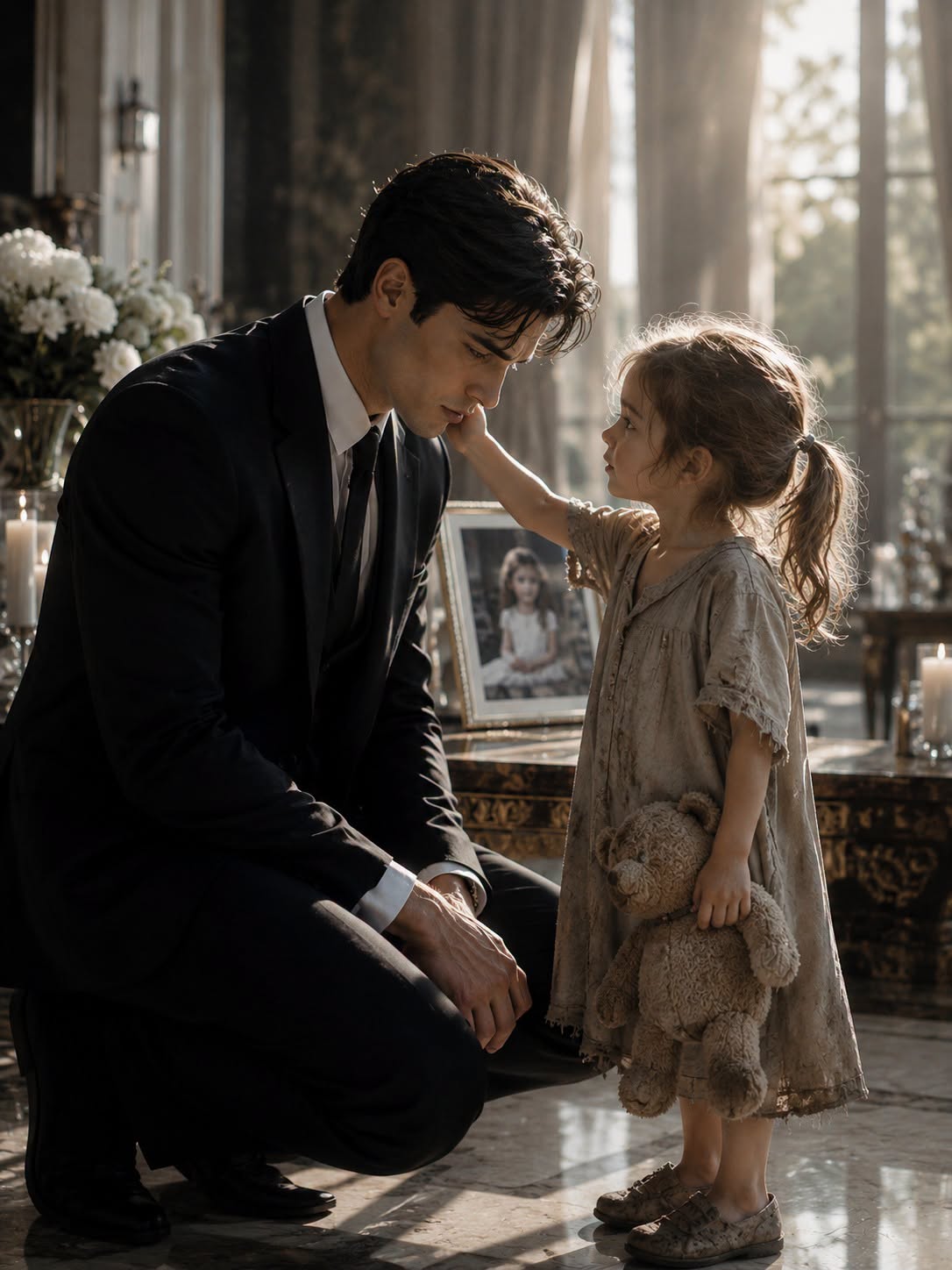
The church had grown significantly colder now that the draft from the opening doors was mixing with the damp stone interior. Father Thomas had retreated to the vestry, his heavy robes rustling like dry autumn leaves, leaving the nave to the ghosts of the morning and the few stragglers lingering by the radiators near the front.
Stellan didn't move. He sat rigidly in his corner of the last pew on the left, his hand tightening around the ashwood cane until the wood pressed painfully into his palm.
The footsteps on the stone floor were light, rhythmic, and unmistakable. Tap, tap, tap. The sole of the left pink sneaker made a faint, wet squeak every time it hit a patch of moisture tracked in from the rain outside.
She stopped three feet from the end of his pew.
Up close, the illusion was terrifyingly complete. She was small—even smaller than she looked from a distance. Her skin had that pale, translucent quality common to children who grew up on boxed macaroni and cheap milk, but her cheeks were flushed pink from the walk through the wind. Her dark hair, thick and untamed, was held back by a blue plastic clip that was missing one of its spring teeth.
She didn't look at his cane. She didn't look at the expensive Italian coat. She looked straight into his eyes with an intensity that felt like a physical weight.
"You dropped something," she said.
Her voice was high, clear, and possessed that slight raspy edge that comes from crying yourself to sleep the night before.
Stellan stared at her. His throat felt as though it had been lined with coarse sand. "I didn't drop anything."
"Yes, you did," the girl insisted, her small chin tilting up with a stubbornness that made Stellan’s breath catch in his throat. She reached into the pocket of her oversized yellow coat and pulled out a small, round object, holding it out flat on her palm.
It was a quarter. Not a new, shiny quarter, but an old one, worn completely smooth around the ridges, the Washington bust flattened almost into a smudge of silver.
"I found it under your bench," she said, taking a deliberate step closer, invading the sanctuary of isolation Stellan had spent two years building around himself. "I think it’s your sad money."
"My what?" Stellan managed to force the words past his teeth.
"Sad money," she repeated, as if explaining something obvious to a particularly slow kindergartener. "My mama says when people look like they’ve got a heavy rock sitting right here"—she tapped her own chest with a grubby index finger—"they usually drop things without knowing it. That means their pockets have holes in 'em."
From six rows up, a frantic, exhausted voice cut through the cavernous quiet of the nave.
"Ren! Ren, what did I tell you about wandering off? Get back here right now."
The young woman—her mother—was hurrying back down the aisle, her face flushed with a mixture of embarrassment and rising panic. She was wearing a thin knitted scarf wrapped twice around her neck, her hands stuffed deep into her pockets. When she reached the last pew, she grabbed the little girl’s shoulder, pulling her back firmly behind her skirt.
"I am so sorry, sir," the mother stammered, her eyes darting nervously to Stellan’s scarred face and the expensive cane. "She’s... she doesn't mean any harm. She gets curious. Come on, Ren. Say sorry to the gentleman."
"I wasn't doing anything bad, Mama," Ren protested, peering out from behind her mother’s faded denim jacket. "I just gave him his quarter back."
"It’s not mine," Stellan said. His voice was too harsh, too loud in the empty church, and he saw the mother flinch instinctively, stepping back half a step as if she recognized the tone of a man who was used to being obeyed without question.
"Keep it," Stellan added, softening his tone by a fraction of an inch—an effort that cost him more than physical pain. "Or put it in the collection box."
The mother’s eyes flicked to the small metal box mounted by the door. Then they flicked back to Stellan, lingering on the expensive fabric of his coat, the cut of his collar, the quiet, dangerous stillness that clung to him like smoke. People from the hills didn't come down to St. Andrew’s unless they were hiding from something, or looking for someone they couldn't find through the normal channels.
"We have to go," the mother said, her voice dropping into a flat, defensive register. She grabbed Ren’s hand with a grip that was a little too tight, a little too desperate. "Come on, sweetheart. The bus isn't going to wait."
"Bye, mister," Ren called out over her shoulder as her mother hauled her down the aisle toward the heavy oak doors. "I hope your rock gets lighter!"
Stellan sat frozen in the dim light of the back pew.
The quarter remained where she had left it, resting on the wooden divider at the end of the bench. He reached out slowly, his long fingers closing around the worn silver coin. It was cold. He brought it up to his palm, closed his fist around it, and squeezed until the edges bit deep into his skin.
He didn't leave immediately after they exited. He sat in the empty church for an hour, watching the dust motes drift through the shafts of pale winter sunlight cutting across the altar.
When he finally stood up, his legs felt stiff, heavy with the realization that the carefully constructed mausoleum of his grief had just been cracked open by a seven-year-old girl with duct tape on her shoes.
He walked out the side door, ignoring the cold rain that had begun to spit from the grey sky.
He didn't get into his grey sedan. Instead, for the first time in two years, he didn't turn toward the highway leading back to the Berkeley hills. He walked three blocks down Fourth Street, past the laundromat with the flickering neon sign, past the boarded-up hardware store, until he reached the corner of Market and 9th.
There, parked against the curb, was a battered 2008 Ford Focus with a rusted passenger door and a bumper sticker that read: SUPPORT EAST OAKLAND PUBLIC SCHOOLS — BEFORE THEY CLOSE THEM.
He watched from the shadow of an abandoned brick warehouse as the mother and daughter walked down the sidewalk three hundred yards ahead of him. He watched them turn into the courtyard of the Oakridge Housing Project—a sprawling, concrete complex of low-income apartments where the windows were reinforced with wire mesh and the courtyard grass had long since turned to mud.
May you like


Stellan pulled his collar up against the rain, turned around, and walked back to his car.
He hadn't found peace. He had found a variable. And in Stellan Voss’s world, a variable was something that had to be accounted for, managed, and controlled—no matter what the cost.


