Chapter 2 - THE ANATOMY OF A GHOST
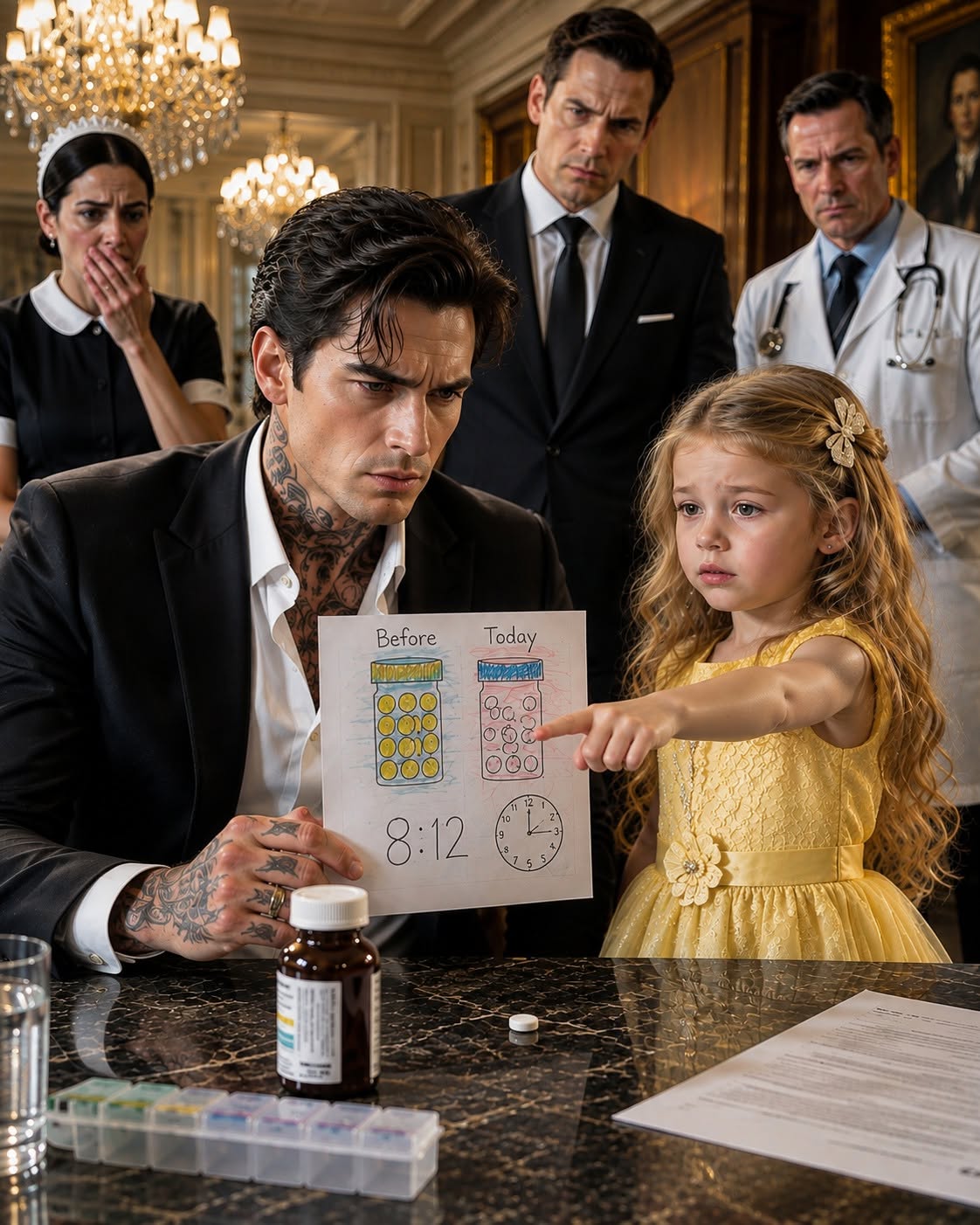
The rain outside had turned into a steady, freezing drizzle that plastered the sprawling oak trees against the wrought-iron perimeter fence. Inside my private study on the third floor, the fire crackled in the hearth, throwing long, dancing shadows across the rows of leather-bound ledgers that lined the mahogany walls.
Gabriel stood by the heavy velvet drapes, his broad shoulders filling out his dark tactical turtleneck. He was a man who spoke in grunts and gunshots, having served as my chief of security for twelve years after leaving the Italian Carabinieri under circumstances that remained comfortably redacted.
“The technicians checked the server room,” Gabriel said, his voice flat as he stared down at the wet courtyard below. “The footage wasn’t deleted from the terminal. The hard drive in the secondary router was physically bypassed using a hardware sniffer. Someone had to plug a mobile bridging device directly into the motherboard inside the junction box.”
“And who has the master keys to the primary junction box?” I asked, swirling a finger around the rim of an empty brandy snifter.
“Three people,” Gabriel replied without hesitation. “Myself. You. And Victor.”
I nodded slowly, the motion feeling heavy, as if my neck had suddenly grown tired of supporting my skull.
“What about the prescription?” I asked, gesturing to the small amber bottle resting on my desk beside the crayon drawing Sophia had made.
“I had our medical contractor, Dr. Althaus, run a preliminary gas-chromatography test in the estate’s private lab an hour ago,” Gabriel said, turning away from the window. His face was grim, hardened by the kind of ugly truths men like us spent our lives trying to outrun. “The legitimate medication is digitalis-derivative compound 7-B. Heart regulator. Slows the pulse, stabilizes ventricular rhythm.”
“And what was in the bottle?”
“Digoxin-analog mixed with potassium-chloride crystals,” Gabriel said quietly. “At the prescribed dosage of one tablet per evening, it wouldn’t kill you instantly. It would mimic the exact symptoms of a severe myocardial infarction within forty-eight hours. Fluid buildup in the lungs, erratic fibrillation, sudden cardiac arrest. To any coroner in the county—especially one whose medical board is heavily funded by the Moretti philanthropic trust—it would look like natural causes. A tragic, expected failure of an old man’s heart.”
I closed my eyes.
For twenty-five years, Victor had stood beside me while rivals fell, while syndicates fractured, while federal prosecutors tried and failed to pierce our corporate veil. He had held my coat during winter operations in Milan; he had poured my coffee when my first wife died; he had been the architect of my survival.
And all the while, he had been calculating the half-life of my expiration.
“Why?” I whispered to the empty room. “If he wanted me dead, he could have put a bullet in my brain a decade ago. He could have slipped something lethal into my wine during any number of private dinners.”
“Because a bullet leaves a trail, Don,” Gabriel said bluntly. “A sudden, violent death triggers an emergency succession protocol. The board takes control. The old guard fights for the succession. It causes chaos, bloodshed, and federal intervention. But a natural death? A peaceful expiration in your study after a long decline? That leaves the estate intact. That leaves the foundation under the control of the chief operating officer.”
He paused, letting the implication hang in the freezing air.
“Victor isn’t just killing you, boss. He’s inheriting you.”
I opened my eyes and looked down at Sophia’s crayon drawing. The white circles. The red circles. The precise timestamp: 8:12.
A five-year-old child sitting under a dusty service table with a box of Crayola crayons had seen what a room full of hardened killers and high-priced security experts had missed for three months.
“How long?” I asked.
“The pharmacy logs show three-month refills,” Gabriel said, stepping closer to the desk. “Every thirty days, Victor personally picked up the prescription from the concierge pharmacy in the city. No couriers. No staff. Just him.”
Three months. For ninety days, every breath I took had been measured, weighed, and timed by the man I trusted with my life.
“Where is Victor now?” I asked.
“In his quarters in the west wing. He hasn’t tried to leave. He’s packing a leather valise, burning a stack of personal ledgers in his fireplace, and pouring himself a glass of your twenty-year single malt. He knows we know, Alessandro.”
I stood up from the leather desk chair, my joints cracking in the quiet room. I walked over to the gun cabinet set into the wood-paneled wall, spun the brass combination dial, and pulled open the heavy glass door.
Inside rested a matte-black Beretta 92FS—a sidearm I hadn't carried since the winter of ninety-eight, when the harbor wars required a personal touch. I lifted it from the velvet foam, feeling its reassuring weight, and checked the magazine. Fully loaded. Hollow-points.
“Bring Elena and Sophia to the safe room in the basement,” I said, not looking at Gabriel. “No one touches them. If anything happens to me tonight, you take that mother and child out of the country on the Gulfstream before dawn. Understood?”
“Understood, Don,” Gabriel said, his hand resting on the butt of his own SIG Sauer. “Do you want me to come with you to the west wing?”
“No,” I said, sliding the Beretta into the inner holster of my wool vest. “Twenty-five years of service deserves a private conversation.”
The west wing of the estate was older than the rest of the mansion, constructed during the Prohibition era by a bootlegger who wanted thick stone walls to muffle the sound of federal raids and midnight reckonings. The hallway was dimly lit by wrought-iron wall sconces that cast flickering amber beams across faded Persian runners.
The door to Victor’s suite was ajar.
A sliver of warm yellow light spilled out onto the dark runner. From within came the faint, smooth notes of an old Chet Baker jazz record playing softly on a vintage vinyl turntable.
I pushed the door open with the palm of my hand.
Victor sat in a wingback leather armchair by a small marble fireplace. He wore a crisp white dress shirt with the sleeves rolled up to his forearms, a glass of amber whiskey resting in his left hand. On the mahogany coffee table before him sat an open leather valise, neatly packed with ironed shirts, a passport case, several bearer bonds, and a heavy, gold-plated signet ring bearing the crest of the Moretti inner council—a ring that had not been worn since my father’s death.
He didn’t look up as I entered. He simply took a slow sip of his whiskey, swirling the golden liquid against the crystal sides.
“I was wondering when you’d come up, Alessandro,” Victor said, his voice as calm and steady as a church bell on Sunday morning. “I expected you twenty minutes ago, but I suppose reviewing the server logs took longer than anticipated.”
I stepped into the room, letting the heavy oak door click shut behind me. I did not draw the Beretta. I kept my hands resting quietly at my sides.
“Twenty-five years, Victor,” I said, my voice barely louder than the crackle of the fire. “We bled together in Palermo. We sat across from federal prosecutors who wanted to put us both away for the rest of our natural lives. When my daughter died, you were the only man who didn’t offer me platitudes—you just sat with me in the dark until dawn.”
Victor finally turned his head. His eyes—pale, intelligent, and entirely devoid of remorse—met mine across the small table.
“And you were a great man, Alessandro,” Victor said softly. “You are a great man. But great men, like old oaks, eventually block the sun from everything trying to grow beneath them.”
“Is that what this is? Gardening?”
“This is survival,” Victor replied, setting his glass down with a precise, measured click. He leaned back in his chair, resting his hands on the leather armrests. “The syndicate is changing, Alessandro. The old ways—the blood oaths, the handshakes, the romantic notions of honor among thieves—they don’t work in a world run by algorithms, offshore shell corporations, and federal wiretaps. You’ve become an icon. A monument. And monuments are expensive to maintain and impossible to pivot.”
“So you decided to become the architect of my funeral.”
“I decided to retire you with dignity,” Victor corrected smoothly. “A quiet, noble passing. State funerals, floral arrangements from governors, a tearful eulogy delivered by myself as your designated executor. The board remains stable. The stock prices don’t fluctuate. The empire continues uninterrupted under new, modern management.”
“And my life?”
“Your life was complete, Alessandro,” Victor said, his gaze unwavering. “You lived seventy-two years of absolute power, absolute wealth, and absolute control. Very few men get to write the final chapter of their own story. I was simply editing the final paragraph to ensure the book didn’t end in a messy, undignified collapse.”
I stared at him—at the man who had managed my medications, who had smiled at my grandchildren, who had stood beside me through every triumph and tragedy of my adult life. The betrayal wasn't loud. It wasn't messy. It was surgical, clinical, and executed with the chilling efficiency of a corporate merger.
“You forgot one thing, Victor,” I said quietly.
Victor raised an eyebrow, a flicker of curiosity touching his silver-tempered features.
“What’s that?”
“You spent twenty-five years planning for every rival, every federal agent, every ambitious lieutenant in the syndicate,” I said, taking two slow steps toward the desk. “You built firewalls around the servers, you rigged the security feeds, you altered the pharmacy logs with the precision of a clockmaker.”
May you like


I paused, letting the silence settle between us like a physical weight.
“You forgot to account for a five-year-old girl with a box of crayons.”


